Particulate matter (PM) is one of the most widely monitored indicators of air quality, but PM is not a single type of pollutant. It is a mixture of solid particles and liquid droplets that can vary in size, shape and chemical composition. These particles can come from sources ranging from construction activities and road dust to industrial processes, combustion and fires.
For that reason, choosing the right PM measurement is not simply a matter of selecting the smallest or largest particle fraction. The right measurement depends on what you are trying to understand, where you’re monitoring, and what decisions the data will support.
PM10, PM2.5 and PM1 provide different views of particulate pollution. Understanding those differences can help organizations develop a monitoring configuration that better matches their application.
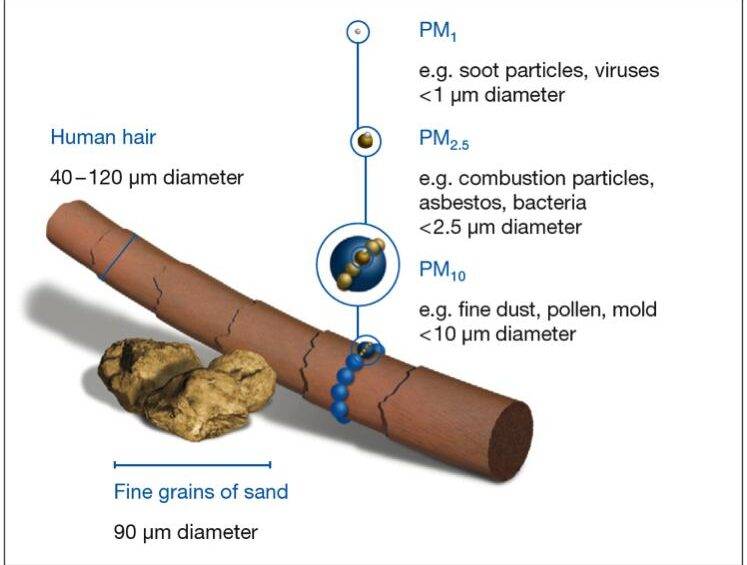
The aerodynamic diameter of the particles defines the PM fractions.
- PM10 refers to inhalable particles with an aerodynamic diameter generally ≤10 micrometres (µm).
- PM2.5 refers to fine inhalable particles with an aerodynamic diameter generally ≤2.5 µm.
- PM1 refers to particles with an aerodynamic diameter ≤1 µm.
Particle size matters because it influences how particulate matter behaves in the atmosphere. Larger particles are more commonly associated with sources such as dust and mechanical processes, while finer particles can be associated with combustion and other processes that generate smaller airborne particles.
However, these fractions should not be treated as completely separate pollutants. PM1 is a subset of PM2.5, and PM2.5 is a subset of PM10.
This means that measuring different PM fractions can provide complementary information about the particulate environment rather than simply identifying one fraction as the “right” measurement.
Why Does Particle Size Matter in Air Quality Monitoring?
Particle size affects how particles behave in the atmosphere and where they can travel and deposit.
The U.S. Environmental Protection Agency (EPA) explains that particulate matter includes particles of different sizes and chemical compositions. Some particles are emitted directly from sources such as construction sites, unpaved roads, smokestacks and fires, while others form in the atmosphere through chemical reactions involving pollutants such as sulfur dioxide and nitrogen oxides.
Particle size is also relevant when considering potential health effects. EPA notes that some particles smaller than 10 µm can penetrate deeply into the lungs, while particles smaller than 2.5 µm can pose particularly significant health risks. However, the potential effects of exposure depend on factors including particle composition, concentration and duration of exposure.
Researchers have also examined the relationship between different PM fractions and respiratory outcomes. A 2024 population-based study of 7,371 adults aged 40 and older in Guangdong, China, found that long-term exposure to PM1, PM2.5 and PM10 was associated with asthma and respiratory symptoms. The researchers reported that the strength of the associations across the three PM fractions was broadly comparable.
These findings highlight why PM1, PM2.5 and PM10 should not necessarily be viewed as competing measurements, as different fractions can provide different information about particulate pollution.
PM1 vs PM2.5 vs PM10: Which Should You Monitor?
There is no single PM fraction that is appropriate for every monitoring project.
The most useful measurement depends on the monitoring objective, pollution source, site characteristics and applicable project or regulatory requirements.
Construction and Demolition
Construction and demolition activities can generate significant amounts of airborne dust. PM10 can therefore be an important fraction to consider when monitoring dust emissions.
However, this does not mean that PM10 is the only fraction that should be measured.
Depending on the activities taking place, PM2.5 may also be relevant. The appropriate configuration should reflect the site’s sources, monitoring objectives and requirements.
Wind direction and speed can also provide valuable context when assessing changing particulate concentrations and potential transport from a site.
Wildfire Smoke
Wildfire smoke can contain substantial amounts of fine particulate matter, making PM2.5 an important measurement for understanding smoke-related air-quality conditions.
PM1 can provide additional information about the finer particle fraction, while PM10 captures particles across a wider size range, including those larger than PM2.5.
For wildfire monitoring, it can therefore be useful to consider more than one PM fraction, alongside meteorological parameters such as wind direction and wind speed, which can help explain smoke transport and dispersion.
Urban and Ambient Air Quality
Ambient air-quality monitoring often requires a broader view of particulate pollution.
PM2.5 is an important measurement for fine particulate pollution, while PM10 provides information about the wider inhalable particle fraction.
Depending on the monitoring objective, organizations may also need to consider gaseous pollutants such as nitrogen dioxide (NO₂), ozone (O₃), carbon monoxide (CO) or sulfur dioxide (SO₂), as well as meteorological conditions.
Industrial Applications
Industrial facilities can generate particulate matter through a wide range of processes, so there is no universal PM fraction that applies to every facility.
The appropriate measurement may depend on:
- The industrial process
- The source of the emissions
- Particle characteristics
- Site conditions
- Regulatory or permit requirements
- The purpose of the monitoring program
In some applications, particulate monitoring may also need to be combined with measurements of relevant gaseous pollutants.
Mining and Dust Monitoring
Mining, material handling and similar activities can generate airborne dust across a range of particle sizes.
PM10 can be particularly relevant for monitoring airborne dust, including particles generated by mechanical activities, while PM2.5 provides information about finer particles that may arise from combustion and other sources associated with site operations.
Wind direction and speed can also help explain changes in particulate concentrations around a site and assess the potential transport of dust from its source.
Practical Guide: Which PM Fractions Should You Consider?
The table below identifies the PM fractions of primary concern for different monitoring objectives. It does not mean that other fractions should be excluded.
| Monitoring objective | PM fractions of primary concern | Other parameters to consider |
| Construction and demolition | PM10, PM2.5 | Wind direction and speed, meteorological conditions |
| Wildfire smoke | PM2.5, PM1 | Wind direction and speed, meteorological conditions |
| Urban and ambient air quality | PM2.5, PM10 | Relevant gases, wind direction and speed, meteorological conditions |
| Industrial applications | Depends on the source and process | Relevant gases, wind direction and speed, meteorological conditions |
| Mining and dust monitoring | PM10, PM2.5 | Wind direction and speed, meteorological conditions |
Note: The PM fractions listed represent the primary areas of concern for each monitoring objective, not an indication that other fractions should be excluded. The appropriate monitoring configuration depends on the specific site, monitoring objectives and applicable regulatory or project requirements.
Why Consider Monitoring Multiple PM Fractions?
Measuring multiple PM fractions can provide a more complete picture of particulate conditions.
PM1 is contained within PM2.5, and PM2.5 is contained within PM10. Therefore, the concentrations of these fractions are related, but they can still provide useful information about the distribution of particulate matter across different particle-size ranges.
The 2024 Guangdong study found strong correlations between PM1 and both PM2.5 and PM10. In that study, PM1 represented approximately 59.7% of PM2.5 and 38.4% of PM10 at participants’ residential locations. Importantly, these ratios were specific to the study area and should not be treated as universal values; the proportion of different particle sizes can vary with location and pollution sources.
This is one reason a monitoring strategy should be based on the application and monitoring objective, rather than the assumption that one PM fraction will always provide sufficient information.
PM Monitoring Is Only One Part of Air Quality Monitoring
Particulate matter is an important component of air-quality monitoring, but it may not tell the whole story.
Depending on the application, monitoring programs may also need to consider:
- Ozone (O₃)
- Carbon monoxide (CO)
- Sulfur dioxide (SO₂)
- Volatile organic compounds (VOCs)
- Temperature
- Relative humidity
- Wind direction
- Wind speed
- Other site-specific environmental parameters
For example, changes in particulate concentrations may be easier to interpret when considered alongside wind direction, wind speed and other environmental conditions.
This is particularly important for monitoring programs when the objective is not simply to record particulate concentrations, but to understand how air-quality changes over time and what factors may contribute to those changes.
What Should You Consider When Choosing a PM Monitoring System?
Particle size is only one consideration when selecting a monitoring system.
Before choosing a device, consider:
1. Which PM fractions are measured?
Determine whether the system measures PM10, PM2.5, PM1 or a combination of fractions relevant to your application.
2. What is the measurement range?
The expected concentration range at the site should be considered when evaluating a monitoring system.
3. What other parameters do you need?
If your application requires more than particulate matter, consider whether gases or environmental parameters need to be measured by the same system.
4. Where will the system be deployed?
Indoor, outdoor, industrial, construction, and remote deployments can have very different requirements for power, enclosure, connectivity and environmental protection.
5. How will you access the data?
Consider whether you require cloud-based visualization, API access, integration with an existing platform, offline data access or another data-management approach.
6. What are the maintenance requirements?
Understand the manufacturer’s requirements for calibration, verification, maintenance and long-term operation before selecting a system.
7. What decisions will the data support?
A monitoring system should ultimately be selected based on what you need the data to accomplish — whether that is understanding site conditions, investigating sources, supporting environmental programs, managing dust, or providing data for a specific project requirement.
The Right PM Measurement Depends on the Application
There is no universal answer to the question, “Should I measure PM1, PM2.5 or PM10?”
The better question is:
What do I need to understand about particulate pollution at my site?
Construction and dust-generating activities may place greater emphasis on PM10, while wildfire smoke and other fine-particle sources may place greater emphasis on PM2.5 and PM1. Ambient and industrial monitoring may benefit from measuring multiple PM fractions alongside gaseous or meteorological measurements.
The goal is not necessarily to measure every available parameter. It is to select the measurements that provide meaningful information for the specific monitoring objective.
How AirSENCE Supports Multi-Parameter Monitoring
AirSENCE monitoring systems can be configured for different environmental monitoring applications, combining particulate measurements with selected gaseous and environmental parameters depending on the device configuration.
For projects where understanding changing conditions require more than a single particulate measurement, a multi-parameter monitoring approach can provide additional context around the data.
The appropriate configuration depends on your application, deployment environment and monitoring objectives.
Planning an air-quality monitoring project?
Talk to the AirSENCE team about your monitoring requirements to identify which PM fractions and additional parameters are appropriate for your application.
Frequently Asked Questions
Is PM10 the same as PM2.5?
No. PM10 includes particles with an aerodynamic diameter generally ≤10 µm, while PM2.5 refers to the finer fraction generally ≤2.5 µm. PM2.5 is therefore a subset of PM10.
Do I need to monitor PM1, PM2.5 and PM10?
Not necessarily. The appropriate PM fractions depend on your monitoring objective, pollution sources, site conditions and applicable requirements. In some applications, monitoring multiple fractions can provide a more complete understanding of particulate conditions.
Is PM10 enough for construction monitoring?
Not necessarily. PM10 can be an important fraction for construction and dust monitoring, but PM2.5 may also be relevant depending on the activities, pollution sources and monitoring objectives.
Which PM fraction is important during wildfire smoke events?
PM2.5 is an important measurement for fine particulate pollution associated with wildfire smoke. PM1 can provide additional information about the finer particle fraction, while PM10 can provide a broader view of particulate concentrations.
What other parameters should I monitor alongside PM?
Depending on the application, relevant parameters may include gaseous pollutants, wind direction and speed, temperature and relative humidity. The appropriate combination depends on what you are trying to understand at the monitoring site.
Can one monitoring system measure multiple PM fractions?
Some monitoring systems can measure multiple PM fractions. When evaluating a system, check the manufacturer’s specifications and confirm that the PM fractions, measurement ranges and other parameters meet your project requirements.